drawing 3d objects from different views
Chapter 7: An Introduction to 3D CAD
Contents
About this AffiliateAbout this Chapter
Cardinal Terms in this Chapter
Why 3D CAD?
Pictorial Views Concept
- Oblique Views
- Isometric Views
- Steps to Draw an Isometric
Isometric Drawing-Aid Functions
- Isometric Grid
- Fixed Cursor Direction
- Isometric Circles, Text and Dimensions
- 2D Drawings to Isometrics Conversion
3D Modeling
- Working with 3D Coordinates
- Cartesian Coordinates
- Spherical Coordinates
- Cylindrical Coordinates
Steps to Draw a 3D Model
User-defined Coordinate System
Displaying Views
- View Coordinate Geometry
- Object Coordinate Geometry
- Displaying Isometric Views
- Displaying Plans and Elevations
- Displaying Perspective Views
3D Drawing-Aid Functions
- 3D Ready-made Shapes
- Extruding Objects in the Linear Direction
- Extruding Objects in the Round Direction
- Shading and Rendering
AutoCAD, MicroStation and Cadkey Terms
This chapter describes a number of 3D drawing techniques that are commonly used by CADD professionals. You will learn how to extrude 3D objects from unproblematic 2D shapes, how to take advantage of 3D ready-made objects and how to make the views look realistic.
Bring together AutoCAD Training online - Learn more...
You volition also larn how to display 3D CAD views of a model from different angles.
Although the actual working of 3D CADD varies from program to program, the principles described here tin exist applied to nigh programs.
| | |
| Isometric | A view of an object tilted at 30° on both sides. |
| Oblique view | A view of an object drawn by taking parallel projections from an meridian. |
| Perspective | A view of an object showing true angles as they would appear from a specific signal. |
| 3D modeling | A CADD capability that allows you to describe objects as concrete objects having length, width and height. |
| 3D coordinates | The manner of measurement used to specify the length, width and height of objects created by 3D modeling. |
| Viewpoint | The point from where a 3D model is viewed. |
| Linear extrusion | A 3D technique that allows you to form 2nd shapes into 3D shapes forth a linear path. |
| Radial extrusion | A 3D technique that allows you to form 2nd shapes into 3D shapes forth a round path. |
Why 3D CAD?
Designers often utilize 3D to visualize designs and to make presentations. Information technology helps them understand how an object will appear from different angles. Using additional rendering programs can further enhance the drawings.
Although working with 3D CADD programs is quite circuitous, information technology is worth the actress try to make employ of them. Many users never take the time to learn the 3D capabilities of CADD. This can be a major disadvantage because the full potential of CADD is never explored.
The views that we draw on two-dimensional media are a second representation of 3D images. We create isometrics and perspectives on paper by cartoon objects as they would appear from a specific bending and altitude. The same concept is used in CADD to describe pictorial views.
There are two distinct ways to draw 3D views with CADD: You lot can depict views using simple 2D functions or using CADD's special 3D functions.
The 2nd functions permit you to draw views just like on a cartoon lath. You tin can draw a view using lines, arcs, or other second objects. This is the quickest method to describe simple isometric and oblique views. However, a view created this way is static; just like a view created on a drawing lath. If y'all need to view the object from a different angle, y'all volition have to draw it once again from scratch.
CADD provides special 3D functions that permit you lot to create 3D drawings that are truthful representations of an actual model. These drawings can be viewed from whatever angle just similar a physical model. That is why 3D CADD drawings are chosen 3D models.
The major distinction between a 2D drawing and a 3D model is that a 2d drawing is defined only with ii coordinates (X and Y). A 3D model is defined with three coordinates (10, Y and Z). The Z-coordinate determines the pinnacle of an object. To brand a 3D model, yous demand to consider all the objects of the model in 3D infinite and enter the X, Y and Z coordinates for all cartoon objects.
3D modeling is usually a dissever CADD module that has its own set of functions. Some manufacturers market 2nd programs and 3D programs every bit separate packages while others combine them into a single program.
The 3D models fall into the following categories:
When you depict a model with lines and arcs, they are called wire-frame models. These models announced to be made of wires and everything in the groundwork is visible. This does not create a very realistic effect.
Surface models are more realistic than wire-frame models. They are created by joining 3D surfaces rather than bare lines and arcs. A 3D surface is similar a piece of newspaper that can have whatever dimension and can be placed at any bending to define a shape. Just like a paper model, you join surfaces to form a surface model. The views displayed from these models are quite realistic, because everything in the background can be subconscious.
Solid models are considered solid inside and not hollow like a surface model. They appear to be the same as a surface model but have additional properties, such as weight, density and centre of gravity, just like that of a physical object. These models are commonly used as prototypes to study engineering designs.
Example: You tin can draw a 3D model every bit a wire-frame, a surface model or a solid. To draw a 3D model of a cube as a wire-frame, yous demand to draw twelve lines by specifying 3D coordinates for each of its points. To describe it as a surface model, you need to draw all six surfaces of the cube. Although you see only iii planes of the cube in forepart, it is essential to draw all the planes when drawing a 3D model. This ensures that a realistic view is displayed when it is rotated to display a view from any angle. When drawing a solid you can also specify its material.
Important Tip:
For general 3D drawings, wire frames and surface models are used. You get-go with a wire-frame model then fill in spaces with 3D surfaces to make it more realistic.
The three axes form three imaginary planes: XY airplane, XZ plane and YZ plane. The XY plane is the horizontal plane and the XZ and YZ are the two vertical planes. When y'all need to describe something horizontal, such as the plan of a building, y'all draw it in the XY aeroplane using X and Y coordinates. This generates a programme view. When y'all demand to draw something vertical, such as an summit of a building, yous depict it using the XZ or YZ planes.
Example: To describe a line in 3D, enter two end points defined with X, Y and Z coordinates. If you need to draw the line lying flat on the ground (XY plane), the Z coordinate for both the end points of the line is null. If you desire to draw the same line at x'-0" above the XY aeroplane, enter the Z-coordinate for both the end points equally x'-0".
The 3D coordinates can exist entered using the post-obit formats:
Cartesian coordinates are based on a rectangular system of measurement. In Chapter 2 "CADD Basics", we discussed how Cartesian coordinates are used in 2D drawings. The same principle is applied to enter 3D coordinates with the exception that you need to enter an additional Z coordinate. Positive Z-coordinate values are used when yous demand to measure distances above the XY plane; negative values are used for the distances below the XY plane.
Coordinate values are entered separated by commas (X,Y,Z). The coordinates can be measured from the origin point (absolute coordinates) or from the concluding reference location of the cursor (relative coordinates).
Spherical coordinates are based on the longitude and latitude arrangement of measurement (Diagram A, Fig. 7.11). Consider the origin point of the coordinate system at the heart of the earth or a transparent globe. And then consider a horizontal plane (XY aeroplane) passing through the center of the earth. To locate a betoken in 3D, first locate a indicate in the XY plane by specifying a radius and an angle (polar coordinates). To specify the top, enter an bending upwards or down from the XY plane (latitude).
Note:
Spherical coordinates are non very efficient for drawing purposes. They are ordinarily used to view a model from unlike angles.
Cylindrical coordinates are unremarkably used to depict cylindrical shapes. They are based on a cylindrical system of measurement. Consider a cylinder placed vertically and the origin point at the center of the cylinder (Fig. 7.12, Diagram A). Cylindrical coordinates are quite similar to spherical coordinates, the difference beingness that the Z-coordinate is specified by height and not bending.
To locate a signal with the cylindrical coordinates, showtime you need to locate it in the XY plane but like polar coordinates. Then indicate an exact height at that betoken.
There are two main protocols used to display views:
View Coordinate Geometry
View coordinate geometry assumes that the camera (viewpoint) remains stationary and the 3D model is rotated to display a desired view. The model tin be rotated around the X, Y, or Z axis. Y'all need to specify around which axis the rotation will have identify and by how much. When you lot rotate the model around the Z-axis, the model rotates in the XY plane; when yous rotate it around the Y-axis, the rotation takes identify in the XZ plane.
Object Coordinate Geometry
Object coordinate geometry assumes that the model remains stationary and the camera (viewpoint) is moved to a brandish a desired view. You tin utilize any of the coordinate methods to specify an exact viewpoint. Spherical coordinates are particularly helpful to indicate a viewpoint.
Comparison: View coordinate geometry tin be compared to property a small model in your mitt and rotating information technology on its sides to get a desired view. Object coordinate geometry can be compared to viewing a building from the heaven. The building remains stationary, while the camera is moved to get a desired view.
Annotation: Virtually CADD programs provide both view coordinate geometry and object coordinate geometry options to display views. Depending on how you want to view a model, you can utilise either method.
To display an isometric, you lot demand to specify the direction from which the view is to be taken. The most appropriate method to signal direction is with the aid of spherical coordinates. Y'all demand to specify two angles: an angle in the XY plane (longitude) and an angle from the XY plane (latitude). The longitude determines the orientation of the model in the XY plane and the latitude determines the pinnacle of the viewpoint.
Important Tips:
You can convert this model into a surface model by drawing 3D surfaces for each of the planes. You can draw a surface for the top of the model by indicating the points I,J,M and L. This model requires a full of seven surfaces for all the sides: top, lesser, four sides and one inclined surface.
You tin can manipulate the views of a 3D model in a number of means. You can rotate the view, cut a department of the view forth a aeroplane, reduce or enlarge the view, change the focus of the view, hide and display certain lines, etc.
You can display more than than one view of a model on the screen at the same time. You tin create a number of viewing windows (viewports) that can be used to display different views. For example, yous can brandish a plan view of the model in 1 viewport, summit in some other and a perspective view in some other. When you describe something in one viewport, information technology is automatically shown in all the viewports.
Avant-garde CADD programs enable y'all to create animated images. Y'all can create perspective views and store them in the estimator memory. You can display a number of these images within seconds to create an blithe event. Y'all can create an event that simulates walking through a building or the functioning of a automobile.
Refer to CADD PRIMER for details on the topics listed above.
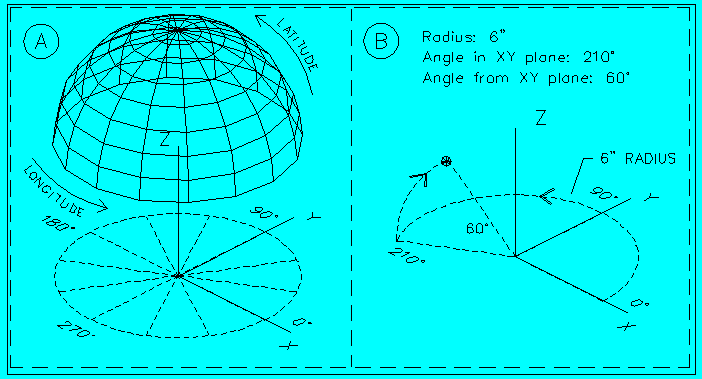
Note: CADD PRIMER is illustrated with more than than 100 diagrams. The above diagram is an example from CADD PRIMER illustrating the concept of spherical coordinates used in CADD.
Join AutoCAD Grooming online - Learn more...
Become a CAD Affiliate and earn 50% commission
Source: https://caddprimer.com/cadd_primer_chapters/isometric_perspective_3d_cad_7.htm

แสดงความคิดเห็น for "drawing 3d objects from different views"